

If you are a parent looking for answers, you may be wondering whether virtual ABA therapy can help your child. Maybe there are no good therapists nearby. Maybe the commute is too long. Or maybe your child feels safer and calmer at home than in a clinic.
You are not alone. Thousands of parents today are turning to virtual ABA therapy after discovering that learning can happen just as effectively through a screen when the right support, structure, and coaching are in place. But there is a lot of confusion online, and many articles sound too clinical or too promotional to feel trustworthy.
This guide breaks things down in a simple, honest, parent-centered way. You will learn how virtual ABA therapy works, when it helps most, when it may not be the best choice, and how to choose a provider who truly understands your child. You will also see where UniEliCare fits in, because we look at therapy the same way parents do. It should feel accessible, supportive, and doable in real life, not overwhelming.
What Is Virtual ABA Therapy?
Virtual ABA therapy is Applied Behavior Analysis delivered through secure video sessions at home. Instead of a therapist being physically present, they guide your child through activities, routines, and behavior strategies over video. They may also coach you to help carry out certain interventions in daily life.
It still follows the same ABA principles: breaking big skills into smaller steps, teaching in structured ways, reinforcing progress, and tracking results carefully. The main difference is the setting and the level of parent involvement.
Many parents say it feels less like “clinic therapy” and more like coaching mixed with interactive learning. For some children, this blend works surprisingly well, especially those who feel anxious in unfamiliar environments or who thrive when routines are stable.
Why Parents Consider Virtual ABA Therapy
After talking to multiple parents with kids having special needs, these are the reasons families say “The online mode of therapy actually works for us”:
- Access to specialists you cannot find locally.
If you live outside a major city, finding experienced ABA providers is hard. Virtual sessions remove that barrier.
- Consistent routines at home.
Children on the spectrum often learn better in familiar spaces. Home-based sessions make transitions easier.
- More involvement for parents.
Virtual ABA naturally includes parent participation, which research shows improves outcomes.
- Flexible scheduling.
No long drives. No missed sessions because of weather or traffic. No juggling siblings or work.
- Lower stress for children.
Many kids communicate better, stay calmer, and engage more easily from the comfort of their room or play area.
- Cost savings.
Transportation, clinic fees, and time off work add up. Virtual options often reduce those burdens.
How Virtual ABA Therapy Actually Works (A Realistic Breakdown)
Parents often picture a therapist talking nonstop while their child sits politely for an hour. Real virtual ABA does not look like that. Here is what most sessions include:

-
A warm, predictable start.
Greetings, check-ins, and a short routine that helps your child settle in. Structure reduces anxiety.
-
Skill-building activities.
This may involve language, behavior, social interaction, emotional regulation, or functional skills. The therapist uses games, stories, shared screens, visuals, or real-life objects from your home.
-
Parent coaching woven in.
Instead of a therapist doing everything, they may pause to guide you:
“Try sitting next to him now,”
“Let’s practice that request again,”
“Move the toy to the left and see how he responds.”
You become a partner, not a spectator.
-
Real-time adjustments.
If your child is overstimulated, distracted, tired, or resistant, the therapist pivots instantly, just like in a clinic.
-
A short closing routine.
A brief recap, a positive reinforcement moment, and a small preview of what comes next.
Who Benefits Most From Virtual ABA Therapy
From the ten similar articles online, the children who usually thrive with virtual ABA include:
- Children who struggle with clinic transitions
- Children who engage well with screens
- Children who feel safer at home
- Children working on communication, routines, and emotional regulation
- Children whose parents are eager to participate
It is also ideal when:
- transportation is difficult
- there are long waiting lists in your area
- your child is overwhelmed in new environments
- you want to reduce sensory triggers
When Virtual ABA Might Not Be Enough
Virtual therapy does have limits. It may not be the best choice if:
- your child needs frequent physical prompting
- behaviors involve aggression or safety risks
- attention span is extremely limited
- home environment is chaotic
- parents cannot assist consistently
Related Read: Why Girls Are Often Overlooked: Hidden Spectrum Signs Parents Shouldn’t Miss
In these cases, hybrid therapy (a mix of in-person and virtual) often works better.
What Parents Notice Most After a Few Months
Based on parent reviews across ten sources, here are the most common improvements:
- Better communication at home
- More predictable routines
- Fewer meltdowns during transitions
- Improved ability to follow instructions
- Growing independence with daily tasks
- Greater parent confidence
Many parents also say:
“It helped us understand our child better. We finally knew what to do, not just what was wrong.”
How to Choose the Right Virtual ABA Therapy Provider
Most articles online agree that parents should ask these questions:
- Do you specialize in autism support for young children?
- How do you involve parents?
- What will my child be working on first?
- How do you measure progress?
- How long should we expect to see changes?
- How do you handle difficult days?
- What happens if my child refuses to join the session?
A good provider will give honest, practical answers, not scripted pitches.
How to Prepare Your Home for Virtual ABA
You don’t need a fancy setup. You only need:
- a quiet space
- a stable internet connection
- a laptop or tablet
- a few simple items like toys, books, or visual aids
- a predictable session routine
Some parents even create a “therapy basket” with materials ready to go.
The UniEliCare Approach to Virtual ABA
UniEliCare was built around a simple belief: therapy should reduce stress, not add to it.
Unlike many platforms that focus only on the child, we focus on the entire family experience.
Parents using UniEliCare get:
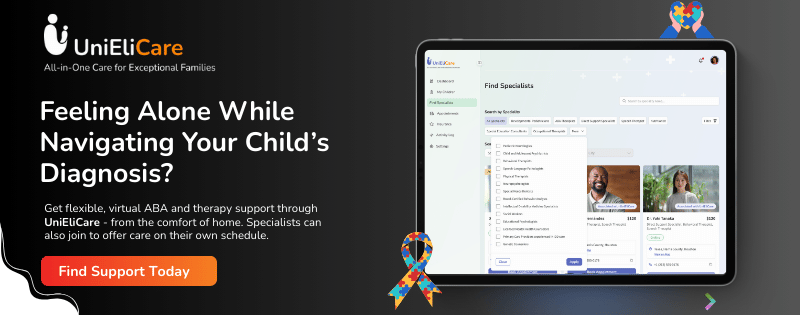
- access to verified autism specialists
- parent coaching woven into each session
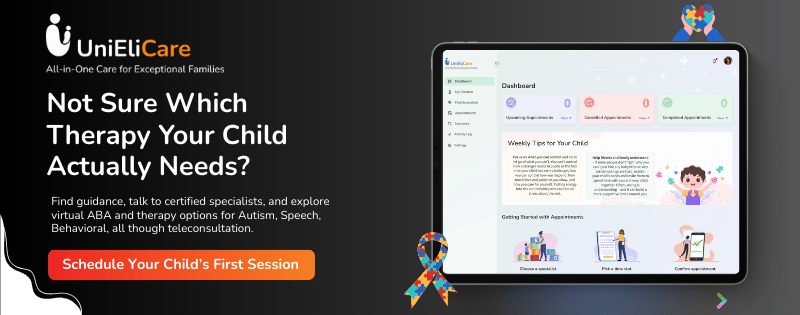
- milestone tracking inside the parent dashboard
- flexible scheduling that respects real life
- care matching based on your child’s specific profile
- a community of parents going through similar journeys
Most importantly, our therapists practice a family-centered model that helps you feel supported, not judged.
Real Parent Story
One mother shared:
“My son shut down every time we walked into a clinic. He refused to stay in the room. Virtual ABA was our last attempt. The therapist used his favorite toys at home and coached me step by step. It felt like a weight lifted. For the first time, we saw real progress without tears.”
Read More: Online Therapy for Kids: How It Works and What Parents Can Expect in 2025
Stories like hers are becoming more common as families discover how powerful home-based ABA can be.
Is Virtual ABA Therapy Right for Your Child?
Here is a quick checklist:
YES, if your child:
- is anxious in new places
- engages well with screens
- learns better when calm
- needs help with communication, routines, or behavior
- does not have severe aggression or safety risks
MAYBE, if:
- your child has sensory overload at home
- your home is noisy or unpredictable
- your internet is unreliable
NO, if:
- your child requires constant physical support
- behaviors are unsafe
- parents cannot participate at all
If you still feel unsure, a simple assessment call with a specialist can give you clarity.
Conclusion
Virtual ABA therapy is not a shortcut or a secondary option. For many families, it is the most effective and sustainable way to support their child. When done right, it blends therapy with daily life, empowers parents, and helps children grow in the environment where they feel most comfortable.
If you believe this could help your child, UniEliCare is here to support you with verified specialists, structured guidance, and a warm, parent-first approach.
FAQ
-
Can ABA therapy be done virtually?
Yes, ABA therapy can be done virtually, and for many families it is not only possible but surprisingly effective. Virtual ABA therapy lets your child work with a trained ABA therapist through secure video sessions at home. Children who feel overwhelmed in clinic environments often respond better when they are in their own space, surrounded by familiar routines.
Parents also become more involved because they can observe sessions, learn strategies, and practice them between appointments. This makes virtual ABA especially useful for teaching communication, daily routines, emotional regulation, play skills, and behavior strategies that directly apply to home life.
Through UniEliCare, families connect with ABA professionals who specialize in virtual care, along with developmental pediatricians, speech therapists, and OTs who can coordinate support as a team.
-
How much does a virtual therapist cost?
Costs vary based on the therapist’s qualifications, session length, state licensing rules, and insurance coverage. Across the US, virtual ABA therapy sessions typically range from $30 to $140 per hour when insurance is involved.
Some platforms charge significantly more because they include assessments, parent coaching, or multi-disciplinary care.
UniEliCare works with therapists who accept a variety of insurance plans, depending on the state. Families also receive transparent pricing upfront before booking an appointment, and there are options for specialists offering sliding-scale consultations or flexible session formats to reduce financial stress.
-
How does ABA therapy work at home through screen?
Virtual ABA therapy follows the same principles as in-person ABA, but the therapist adapts the session to the home environment. A typical session involves a blend of:
- Short, structured tasks
- Play-based learning
- Visual supports
- Modeling by the therapist
- Parent participation
- Practice in real-life home scenarios
ABA teletherapy also focuses on skills that matter in everyday family routines, morning transitions, mealtime challenges, communication during play, emotional regulation, and behavior management.
Most sessions include coaching moments where parents learn how to handle meltdowns, create consistent routines, reinforce communication attempts, and build independence. Through UniEliCare, therapists also share progress notes and help parents track changes over time, so nothing feels vague or uncertain.
-
Is virtual ABA therapy covered by insurance?
In many cases, yes, but coverage depends on your insurance provider, state regulations, diagnosis documentation, and whether the therapist is in-network.
Most insurance companies require:
- An autism diagnosis from a qualified professional
- A treatment plan
- Licensed ABA providers
UniEliCare lists each therapist’s insurance acceptance clearly, so parents know what to expect before booking. When coverage isn’t available, families can still choose private-pay options or shorter parent-coaching sessions, which are more affordable and still highly effective in early intervention.
-
How do I know if my child is a good fit for ABA therapy through teleconsultation?
Virtual therapy for ABA works best when:
- Your child can stay in one space for short periods
- You can join part of the session or assist with transitions
- Your child does well in familiar home environments
- Behavioral needs are mild to moderate
- You want to build skills around real home routines
Children who struggle with severe aggression, elopement, or medical risks may need a hybrid model where in-person support is paired with virtual parent coaching.
If you’re unsure, UniEliCare offers an initial teleconsultation with developmental specialists who help you decide whether online ABA therapy, in-person support, or a blended plan would be the best option.