

For many parents, an autism diagnosis brings a mix of emotions. There is love, concern, hope, and often uncertainty. One of the first questions parents ask is how they can help their child communicate more effectively. This is where autism speech therapy becomes essential.
Across the United States, families in cities like Los Angeles, Chicago, Atlanta, and smaller towns across Ohio or Tennessee share similar concerns. They notice their child struggling to express needs, respond to questions, or engage socially. According to CDC autism prevalence data, autism affects children in every state, and communication challenges are one of the most common reasons families seek early support.
Speech therapy for children offers structured, evidence-based support that helps reduce frustration and build meaningful communication. Importantly, autism speech therapy is not only about spoken words. Communication includes gestures, pictures, signs, facial expressions, and assistive technology. The goal is to help children communicate in ways that work for their daily lives.
Families who come to UniEliCare often say that once they understand how speech therapy services actually work, fear is replaced with clarity. Whether therapy happens in person or through virtual speech therapy, understanding the process empowers parents to support progress with confidence.
What Is Autism Speech Therapy
Autism speech therapy is a specialized service provided by licensed speech-language pathologists. These professionals assess communication abilities and design individualized treatment plans.
Speech therapy for children with autism focuses on:
- Expressive language
- Receptive language
- Social communication
- Speech clarity when appropriate
Some children are learning their first words. Others may speak fluently but struggle with conversation or understanding social cues. Therapy adapts to meet each child where they are.
In states such as California, New Jersey, and Massachusetts, autism identification rates are among the highest in the country, increasing demand for kids speech therapy services. Many families experience waitlists for in-clinic therapy, which has led to growing adoption of online speech therapy for kids.
Why Speech Therapy Is Essential for Children With Autism
Communication challenges affect daily life. When children cannot express needs or understand expectations, frustration often appears as emotional distress or behavioral challenges.
With consistent autism speech therapy, many children experience:
- Improved ability to express wants and needs
- Better understanding of routines
- Increased social engagement
- Reduced communication-related meltdowns
- Greater independence at home and school
Research from the American Speech-Language-Hearing Association consistently shows that early and ongoing speech therapy supports better communication and social outcomes, especially when parents are involved.
Understanding Communication Differences in Autism
Children with autism communicate differently, not incorrectly. These differences reflect how language, sensory input, and social interaction are processed.
Common differences include delayed speech development, limited use of gestures, echolalia, difficulty with back-and-forth conversation, and challenges understanding figurative language.
Autism speech therapy focuses on functional communication that helps children participate in everyday life rather than forcing communication to look a certain way.
How Autism Speech Therapy Supports Emotional Regulation
Communication challenges often affect emotional regulation. When children cannot express needs or discomfort, emotions can escalate quickly.

Autism speech therapy helps children reduce emotional overload by giving them tools to communicate before frustration peaks. Learning to request help, express feelings, or indicate preferences gives children a sense of control.
Therapists also teach emotional vocabulary, helping children identify feelings such as happy, upset, tired, or overwhelmed. Parents frequently report that as communication improves, emotional outbursts decrease and daily routines become calmer.
Speech Therapy Techniques Commonly Used in Autism
Speech-language pathologists use flexible, evidence-based approaches tailored to each child.
Common speech therapy exercises include:
- Imitation games
- Turn-taking activities
- Picture naming
- Sentence expansion
- Story sequencing
- Social role-play
These exercises are practiced during sessions and reinforced at home to support generalization.
Play-Based Therapy
Play-based therapy uses games and activities to encourage communication without pressure, especially effective for younger children.
Visual Supports
Visual schedules and picture cards help children understand expectations and express choices.
Augmentative and Alternative Communication
AAC includes picture systems, communication boards, and speech-generating devices. Research shows AAC supports speech development rather than replacing it.
Speech Therapy for Toddlers and Young Children
Speech therapy for toddler age groups focuses on early communication foundations such as joint attention, imitation, first words, and gestures.
Early childhood is a period of rapid brain development. Studies on early brain development from the National Institutes of Health show that early intervention supports stronger long-term learning pathways. This is why early speech therapy is often recommended as soon as delays are noticed.
Speech Therapy for Children in School and Social Settings
As children grow, communication demands increase. Speech therapy for children in school settings focuses on classroom participation and peer relationships.
Goals may include understanding instructions, asking questions, participating in discussions, telling stories, and navigating friendships. Parents in states like Illinois, Virginia, and California often report improved confidence once therapy aligns with school expectations.
What Happens During a Speech Therapy Session
Sessions may take place in clinics, schools, homes, or through virtual speech therapy platforms.
A typical session includes:
- Warm-up interaction
- Targeted communication practice
- Play-based learning
- AAC use when appropriate
- Parent coaching
Sessions typically last 30 to 60 minutes and occur one to three times per week.
Speech Therapy Evaluation and Progress Tracking
A speech therapy evaluation includes parent interviews, standardized assessments, play-based observation, communication sampling, and developmental history review.
SOAP Note Example Speech Therapy
Therapists track progress using SOAP notes.
Example:
- S: Parent reports increased word use at home
- O: Child independently requested items using two-word phrases
- A: Improved expressive language and reduced prompting
- P: Continue expanding sentence length
This ensures measurable, documented progress.
How Much Does Speech Therapy Cost
Parents often ask how much does speech therapy cost. Costs vary by region and provider.
Typical ranges:
- In-person sessions: $100 to $150 per session (approx)
- Virtual sessions: $80 to $130 per session (approx)
When considering speech therapy cost, it is helpful to look at long-term value. Early communication support often reduces the need for more intensive services later.
Virtual and Online Speech Therapy Options
Online speech therapy for kids allows families to access licensed therapists regardless of location.
Virtual therapy benefits include:
- No travel time
- Home-based learning
- Increased parent involvement
- Faster access to care
Many families begin with virtual speech therapy while waiting for in-person services.
Why Online Speech Therapy for Kids Works in Real Life
Virtual sessions allow therapists to observe children in natural environments. This makes it easier to target real-life communication challenges.
Children often feel more relaxed at home, which improves participation. Parents benefit from live coaching and immediate application of strategies, leading to faster skill carryover.
Also Read: What a Good Online Special Needs Therapist Actually Does in Session (Beyond Just Talking on a Screen)
Speech Occupational Therapy and Sensory Support
Speech occupational therapy integrates speech and occupational therapy strategies to support sensory regulation and attention.
Speech OT Therapy
Speech OT therapy is particularly helpful for children with sensory sensitivities that interfere with communication.
Spasmodic Dysphonia Speech Therapy
Spasmodic dysphonia speech therapy focuses on breathing techniques, vocal control, and reducing vocal strain. While rare in children, therapy can support vocal health when necessary.
How UniEliCare Supports Families Through Autism Speech Therapy
Finding the right therapy support can feel overwhelming, especially with long waitlists or fragmented services. UniEliCare was created to simplify this journey.
UniEliCare connects families with verified, autism-experienced speech-language pathologists and emphasizes parent involvement as part of therapy. Sessions are designed to help parents confidently apply strategies throughout daily routines.
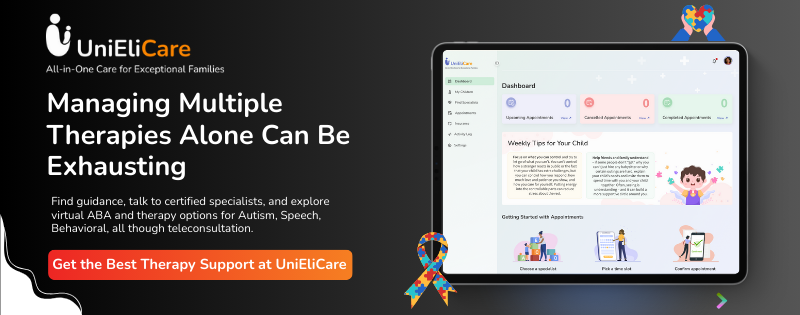
Through secure virtual speech therapy, families can begin services without delays caused by geography or clinic availability. Parents can track progress, review therapy notes, and maintain consistent communication with therapists, supporting continuity as goals evolve.
The Role of Parents in Speech Therapy Success
Parents are essential partners in therapy success.
Helpful strategies include practicing skills during routines, giving children time to respond, encouraging all communication attempts, and maintaining predictable routines.
Parents across states like Arizona, North Carolina, and Washington often report increased confidence after learning therapist-guided strategies.
How Long Does Autism Speech Therapy Take
Progress timelines vary based on age at start, frequency of sessions, family involvement, and individual strengths. The focus is meaningful, steady improvement rather than speed.
Frequently Asked Questions About Autism Speech Therapy
1. When should my child start autism speech therapy?
A child can start autism speech therapy as soon as communication delays or concerns are noticed. This may include limited eye contact, lack of gestures, delayed speech, difficulty responding to their name, or frustration when trying to communicate. Many families begin therapy between 18 months and 3 years, but earlier support is often beneficial.
Starting therapy early does not mean rushing a diagnosis. It simply provides guidance during a critical stage of development. Families on UniEliCare often begin with early virtual consultations to understand next steps while deciding on longer-term care.
2. What does an early intervention speech therapist do?
An early intervention speech therapist works with infants, toddlers, and young children to build foundational communication skills. This includes helping children develop joint attention, imitation, early sounds, gestures, understanding simple instructions, and first words.
A key part of early intervention is parent coaching. Therapists guide caregivers on how to encourage communication during everyday routines like meals, playtime, bath time, and reading. On UniEliCare, this parent-focused approach is central, helping families support progress consistently outside therapy sessions.
3. What is the earliest age for speech therapy?
Speech therapy can begin as early as 12 months, and sometimes earlier if there are concerns related to feeding, sound production, or social engagement. Many children start early intervention speech therapy before age 3, when language development becomes more noticeable.
Early therapy focuses on interaction and communication readiness rather than structured speech drills. Families who access UniEliCare early often appreciate the ability to consult a licensed therapist virtually without waiting for local availability.
4. What are the 5 pillars of early intervention?
Early intervention is typically built around five core pillars:
- Communication development, including speech, gestures, and understanding language
- Social interaction, such as joint attention, turn-taking, and engagement
- Cognitive development, including learning through play and problem-solving
- Motor development, covering both fine and gross motor skills
- Family involvement, ensuring strategies are practiced consistently at home
Speech therapy plays a central role across all five pillars. At UniEliCare, therapy plans emphasize family involvement so communication strategies naturally integrate into daily routines.
5. What is an example of early intervention?
One example of early intervention is a toddler who is not using words yet receiving speech therapy focused on imitation, gestures, and early sounds. The therapist may use play-based activities and coach parents to model language during daily routines.
Another example is a preschool-aged child receiving coordinated speech and occupational therapy to support communication, attention, and sensory regulation. Through UniEliCare, families often access this support virtually, allowing therapists to guide strategies within the child’s home environment.
6. Can speech therapy help nonverbal children with autism?
Yes. Speech therapy supports communication in many forms, not only spoken words. Nonverbal children may use gestures, pictures, sign language, or AAC devices to communicate effectively.
Speech therapy focuses on helping the child express needs, make choices, and interact socially. Many children who start with AAC later develop spoken language, while others continue using alternative communication successfully. UniEliCare therapists help families understand and support whichever communication method works best for their child.
7. Will my child eventually speak?
Every child’s communication journey is different. Some children with autism develop spoken language over time, while others rely on alternative methods such as AAC. The goal of autism speech therapy is not to force speech, but to ensure the child can communicate effectively and confidently.
Progress depends on many factors, including early support, consistency, and individual strengths. Families often find reassurance in focusing on functional communication rather than specific outcomes.
8. How often should speech therapy sessions take place?
Most children attend speech therapy one to three times per week, depending on their needs, goals, and tolerance for sessions. Frequency may change over time as skills develop.
Therapists on UniEliCare often adjust session plans based on progress and family routines, helping therapy remain manageable and sustainable.
9. Is online or virtual speech therapy effective for children with autism?
Yes. Research and clinical experience show that virtual speech therapy can be highly effective, especially when parents are involved. Online sessions allow therapists to observe children in their natural environment and coach parents in real time.
Many families choose UniEliCare’s virtual therapy options to begin services sooner, reduce travel stress, and improve carryover of communication strategies at home.
10. How can parents support speech therapy at home?
Parents can support therapy by practicing strategies recommended by the therapist, giving their child time to respond, acknowledging all communication attempts, and keeping routines predictable.
Even small changes, such as narrating daily activities or offering choices, can reinforce therapy goals. UniEliCare emphasizes parent education so families feel confident supporting communication throughout the day.
Conclusion
Autism speech therapy helps children build communication skills that improve confidence, independence, and connection. Whether delivered in person or through online speech therapy for kids, consistent and individualized care makes a meaningful difference.
Related Read: Virtual ABA Therapy: A Parent’s Guide to At-Home Support for Autistic Children
Families across the United States face different access challenges, but the need for clear, compassionate support is universal. UniEliCare helps bridge these gaps by combining expert care, virtual access, and parent empowerment.
With early intervention, informed parents, and collaborative support, children with autism can develop communication skills that honor who they are and support their growth.